

Put a bird on it!
See every question.
Answer on your terms.
Every app, TV, and gadget on your network starts with a DNS lookup. WrenDNS answers them in microseconds, blocks what you don't want, and shows you exactly who asked what.
Why WrenDNS
Four promises
See
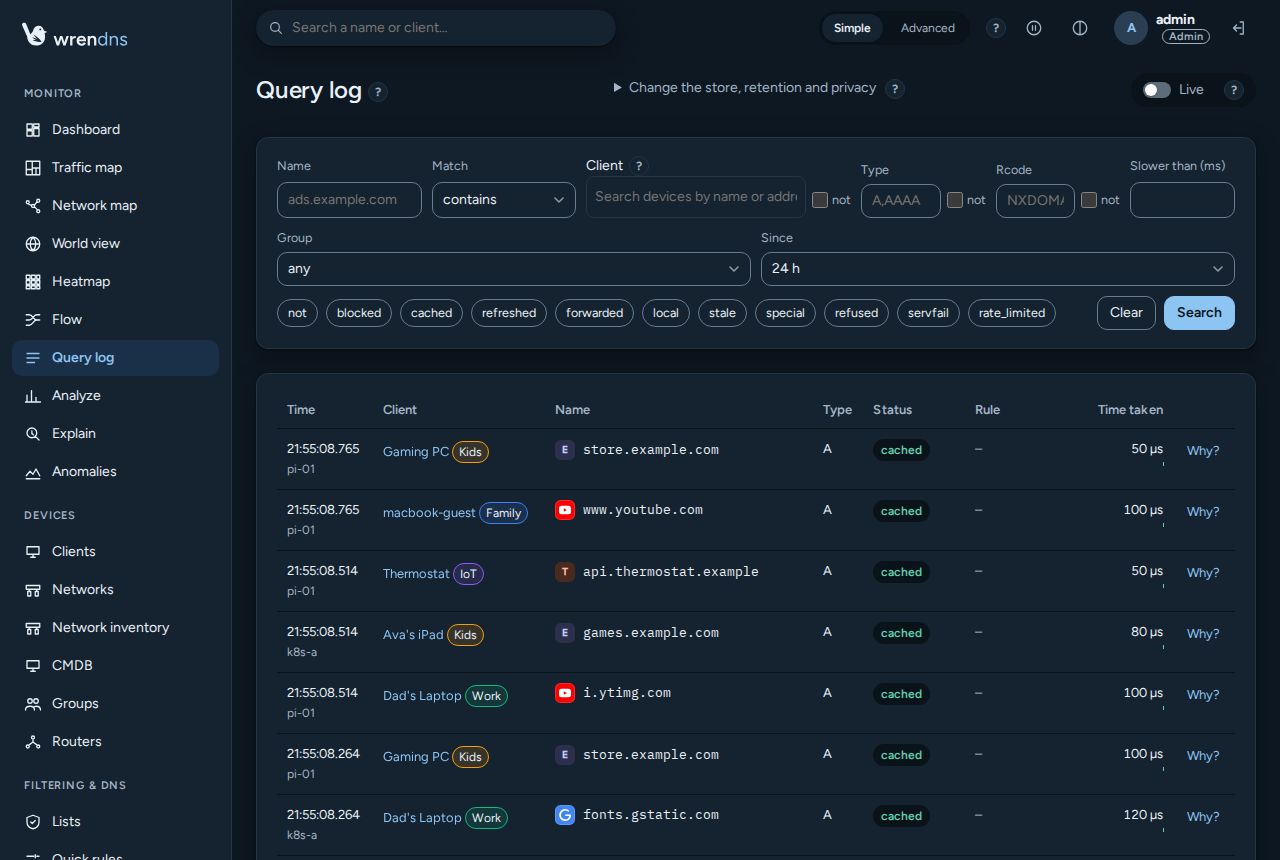
Every question is tied to a device, explained (why it was blocked or allowed), and timed step by step.
Decide
Your rules, per device or group: block ads, trackers, or whole services, on a schedule if you like.
Never fail
Keeps answering from what it knows, even when upstream servers or its own control plane are down.
Run anywhere
The same tiny program on a $35 Raspberry Pi, in Kubernetes, or both at once as one system.
Two ways in
Starts on a Pi. Grows into Kubernetes.
🍓 Your home network
One small program on a Raspberry Pi, a Linux box, or Docker. Point your router's DHCP at it and every device is filtered, encrypted, and explained.
Get started →☸️ Your Kubernetes cluster
One Helm chart: resolver pods that scale, one IP for DNS and the web UI, a Pi as the second server, pods named by their workload, and failover drills that prove your second server works.
What you get on Kubernetes →Standing on the shoulders of giants
Inspired by Pi-hole and Technitium
WrenDNS exists because two projects showed what self-hosted DNS can be. We're grateful to both communities, and if either one already serves you well, keep using it.
Pi-hole
Brought network-wide ad blocking to millions of homes, on a $35 computer, with a dashboard anyone can read. Its blocklist formats, regex rules and Teleporter export are a shared language, and WrenDNS reads them as they are.
Technitium DNS Server
Showed how complete a self-hosted DNS server can be: encrypted DNS, real zones, and a capable web console. Its API makes bringing a setup across to WrenDNS straightforward.
WrenDNS is an independent, clean-room project under the AGPL-3.0-or-later: it uses their public documentation and data formats, not their code.
Where we put our focus
What WrenDNS is built around
✓ available now◐ partly done
| Every CPU core answering, with no pauses | ✓ |
|---|---|
| "Why was this blocked?" down to the list and line | ✓ |
| Per-question timing and percentiles, per device | ✓ |
| Per-network rules: each VLAN or device group gets its own lists, schedules, safe search, and upstream servers: see how | ✓ |
| Try a change against yesterday's real traffic before you save it: what it would have blocked, allowed, or rerouted, by device | ✓ |
| Knows what each device is (a Roku player, a camera, a thermostat) from its maker and the names it asks for, and suggests a name and a group | ◐ |
| Encrypted DNS both ways (DoT / DoH), and DNSSEC validation | ✓ |
| Keeps answering when upstreams fail (serve-stale) | ✓ |
| A small footprint: about 50 MB on a Pi 4 with 2.7 million blocked names | ✓ |
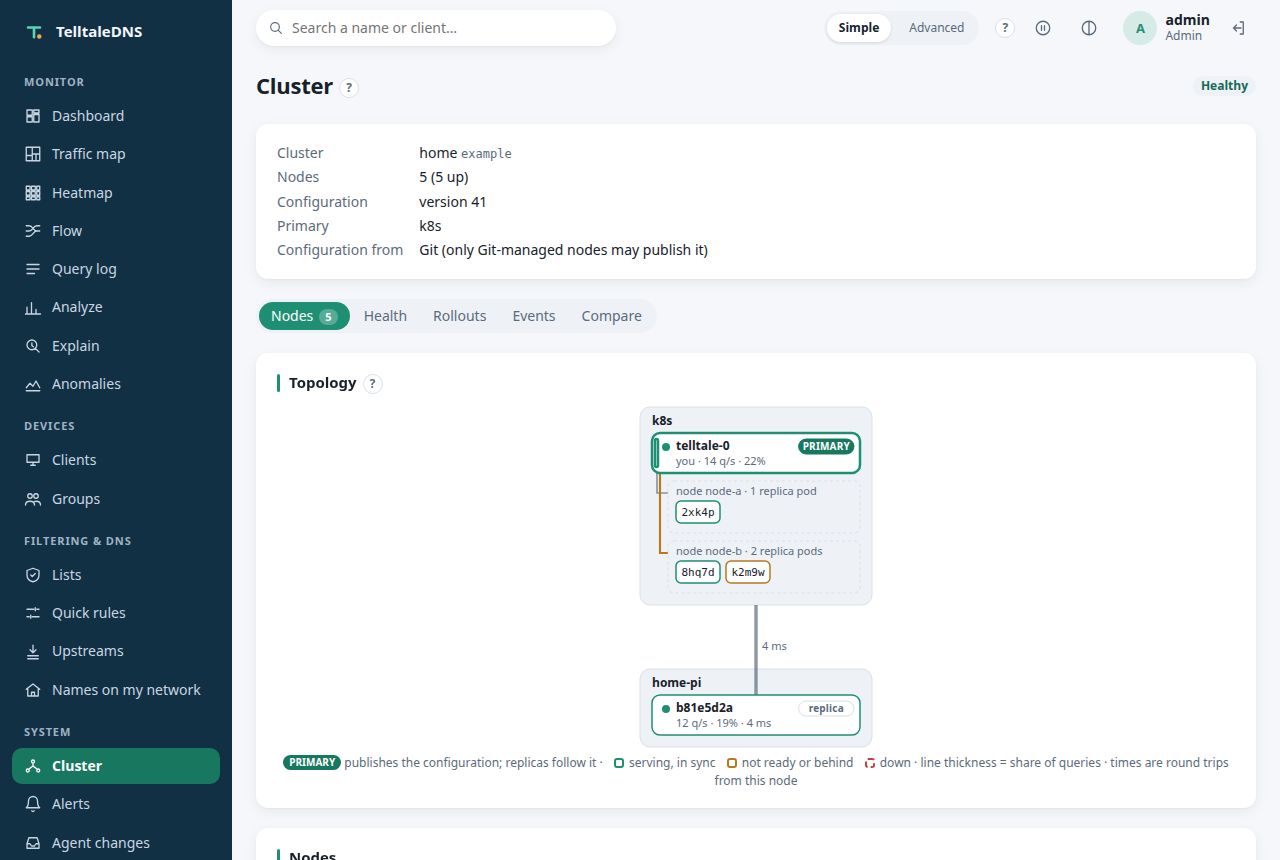
| One cluster across a Pi and Kubernetes, managed from any node | ✓ |
| Kubernetes pods named by the workload that runs them, one device across every rollout: see how | ✓ |
| Failover drills: take a server out on purpose and see which devices really move to the other one: see how | ✓ |
| Changes reach a few canary nodes first, and the cluster goes back to the last good version by itself if they start failing | ✓ |
| Planned maintenance: take a node out of service for a while, with no dropped queries and no false alarms | ✓ |
| Prometheus metrics and a Grafana dashboard built in | ✓ |
| Safe AI-agent access (scoped tokens or SSO; MCP changes as plans you can approve): see how | ✓ |
| Easy to try: imports a Pi-hole or Technitium setup | ✓ |
Throughput numbers come only from the project's reproducible benchmark (Performance). How it all fits together is on the For nerds page.
The web UI
Built into the binary
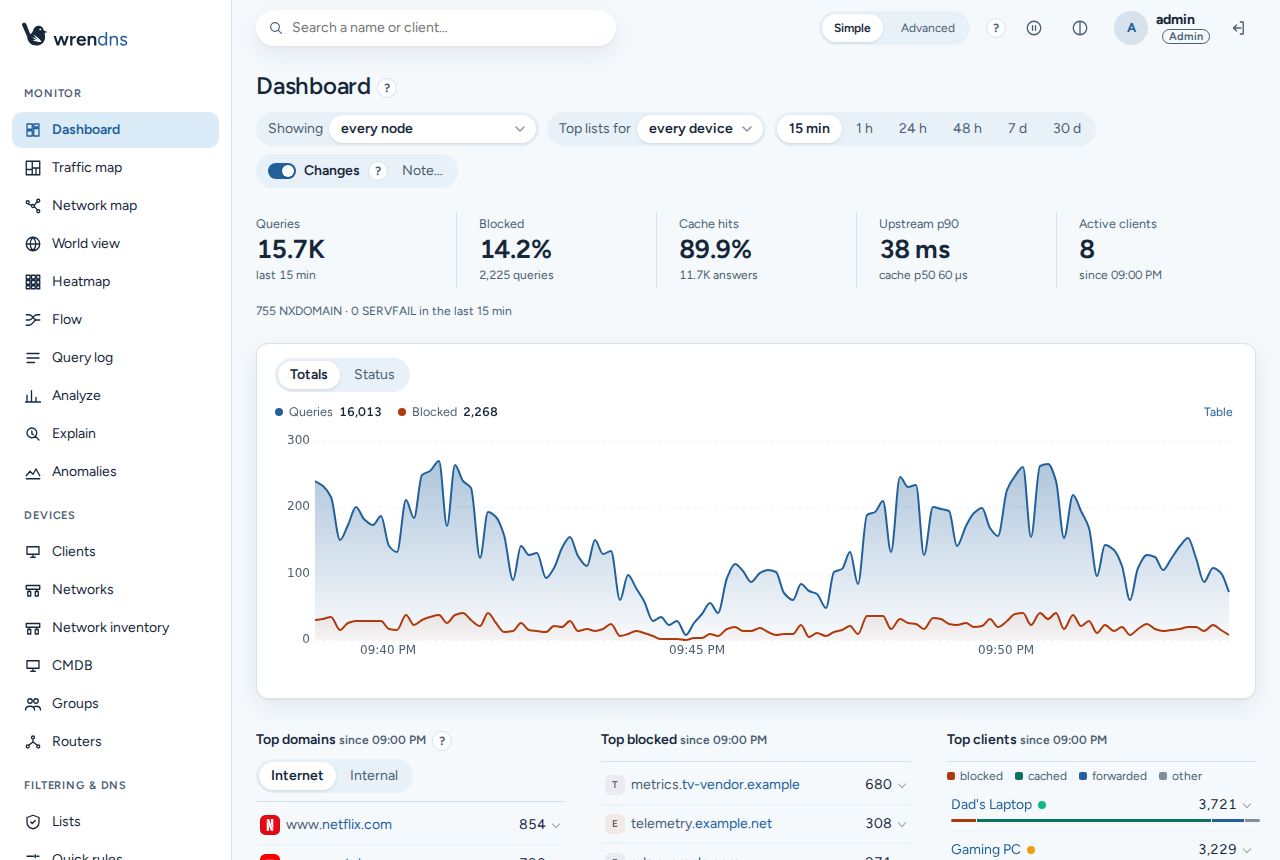
A dashboard, a searchable query log with a "Why?" on every row, devices and groups, lists, upstreams, local names, and the cluster, in light or dark, on a desktop or a phone. Take the tour →
Fast by design
Measured in nanoseconds
Answers come from a cache that stores finished replies and only patches the parts that change. No garbage collector, no pauses, and every core works independently.
Optional
Support WrenDNS
WrenDNS is free to use. If it helps your network, you can support its development.
Give once $3 a month $5 a month $10 a month
Support payments are not tax-deductible. See the terms for refunds, or contact us.